

Retail Sales Continued to Grow in July
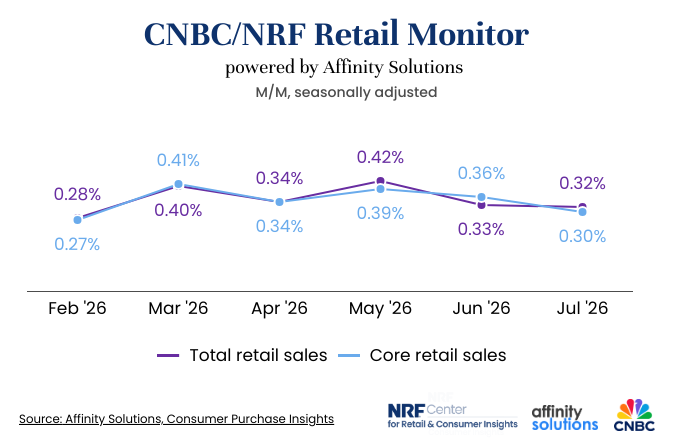
U.S. consumers remained resilient last month, with retail sales posting their tenth consecutive month of growth. Total retail sales excluding autos and gas were up .32% month to month and 5.15% versus July 2025.
The increases weren’t across-the-board, however: as the electronics/appliances and digital products categories both increased by around 12%, sporting goods, hobbies, music and bookstores saw softer sales and mild decreases.
Spending continues to expand despite mixed economic signals, with promotions and seasonal back-to-school demand helping to maintain momentum. (National Retail Federation: August 10, 2026)
Retailers Stock Up Early for the Holidays
We can already tell that U.S. retailers will enter the 2026 holiday season well-stocked.
Many stores are importing merchandise earlier than usual to get ahead of new tariffs, geopolitical uncertainty, and shipping risks. Imports rose 13.2% year-over-year in June, with July and August expected to be lower once everything has been reported.
Consumers should see strong product availability during the holidays, while ports and logistics providers may experience a quieter-than-normal peak shipping season. (Supply Chain Dive: August 12, 2026)
Consumers Increasingly Skeptical of the Internet, AI
Americans are growing more uneasy about life online, according to a recent survey from Incogni.
Of the 1,000 U.S. adults surveyed, more than half expect their personal data to eventually be exposed in a breach. Half of them regret sharing certain information online, and 43% believe they spend too much time-consuming digital content.
Adding fuel to the fire of distrust is artificial intelligence, with nearly half saying that AI-generated content makes it harder to tell what is and isn’t real. Many have responded by simply stepping away; 58% have deleted at least one social media or messaging account because of stress, anxiety, and privacy concerns. (EMARKETER: August 10, 2026)
Communal TV Viewing Makes a Comeback This Summer
Even in a world of fragmented video viewing, TV networks and streamers have found success not only with viewers viewing, but with viewers viewing with other viewers who are also viewing. One might more succinctly call it “co-viewing.”
Fans have watched more than 19 billion minutes of Love Island USA on Peacock, and nearly half of that audience was co-viewing. The World Cup became an even bigger shared event, as nearly 63 million tuned in across Fox, Telemundo, and Peacock for the Spain-Argentina final, making it the most-watched match in U.S. history.
With seemingly infinite video options, watching with friends and family adds a big element of enjoyment and engagement. (The Wrap: August 6, 2026)
This Week in Video History
August 14, 2003 – The Northeast Blackout
Those of us who were preparing 2003/04 recommendation decks and weren’t in the habit of saving our work regularly remember this day well. At around 4pm on what was an otherwise unremarkable Thursday, the lights went out. The computers went off. The work was lost. Across eight U.S. states, 45 million people were affected, and it took a couple of days for power to be fully restored. The cause: A Cleveland-area power company’s perfect storm of a deteriorating system, overgrown trees, and its alarm system’s software bug. Watch WABC-7’s reporting on how NYC was affected.
